Read abstract
Structural theories describe economic brokerage as an opportune but fragile position bridging gaps between otherwise disconnected actors. In that view, brokering can undermine trust or eliminate the gaps that generate its value, and brokers need supporting institutions or deeper interpersonal ties to stabilize their role. Yet many corporate actors in positions of brokerage, from Visa to Amazon, have risen in market power, profit, and prominence even as networks transformed around them. When can brokering strengthen rather than undermine a broker’s advantage?
I reconceptualize brokerage as outsourced relational work, in which the broker assumes no inventory risk and constructs viable matches between parties who cannot easily find or evaluate one another. Repeated matchmaking generates an informational byproduct that the broker can accumulate: knowledge of what makes pairings successful across the market, unavailable to clients who observe only their own dealings. An agent-based model of a matching market identifies conditions under which this informational advantage emerges and persists. Brokerage can provide assessment rather than access: clients outsource matching even when they can reach counterparties themselves, because the broker’s predictions are valuable. Counterintuitively, the broker can become most central in regimes where it engages in the least bridging behavior: broker centrality is a product, not a primary source, of matchmaking quality.
While the model explores the dynamics of the broker’s informational advantage, I theorize how this advantage can support a transition from intermediation to capture by the broker, as the broker becomes a principal selling the resource it once intermediated or monetizing data and analytics. Brief examples illustrate this transition. This is transient brokerage, a process that highlights how brokerage can disappear because of the broker’s growing power rather than its fragility.
Context
After the digital turn
What happens when market matchmaking is outsourced to corporations using digital technologies to operate at scale?
Within the relationship
The parties do the work themselves
Finding each other, sizing each other up, negotiating terms, anticipating what comes next.
Handed to a third party, at scale
One actor does it across millions of relations
It sees every side of every match at once.
The third party comes to know more than any party it serves.
The puzzle
The brokerage puzzle
Theory says
Brokerage is fragile
Brokering can undermine trust or eliminate the gaps that generate its value, and brokers need supporting institutions or deeper interpersonal ties to stabilize their role.
Yet in fact
Brokers became giants
Yet many corporate actors in positions of brokerage, from Visa to Amazon, have risen in market power, profit, and prominence even as networks transformed around them.
When can brokering strengthen rather than undermine a broker's advantage?
A simulated matching market
Many clients, one broker
Each client sees only its own dealings. The broker sees across all of them and pools what it learns.
- 1 agent-based model in Julia, with 500 to 1,500 agents
- 98 effective market conditions
- 20 seeds per condition, 50 at baseline
- 1,990 simulated runs
Agent-based simulation as a bridge from social theory to testable predictions.
The argument
Brokerage is outsourced relational work.
Through it, the broker learns about cross-market complementarities.
- 01The broker matches parties who can't easily find or evaluate each other.
- 02Each match leaves an informational byproduct the broker accumulates.
- 03The broker gets better at evaluating the value of potential matches.
- 04Shielded by the corporate form, the broker accumulates data and builds information architectures.
- 05The broker can use this informational advantage to transition from broker to principal.
Brokerage can disappear because of the broker's power, not its fragility.
Example Amazon hosts third-party sellers, sees what sells best, then enters those lines and competes with them.
Example Former broker-dealer associations turned for-profit stock exchange groups now make most of their profit not directly from intermediation activity, but from selling data feeds and analytics.
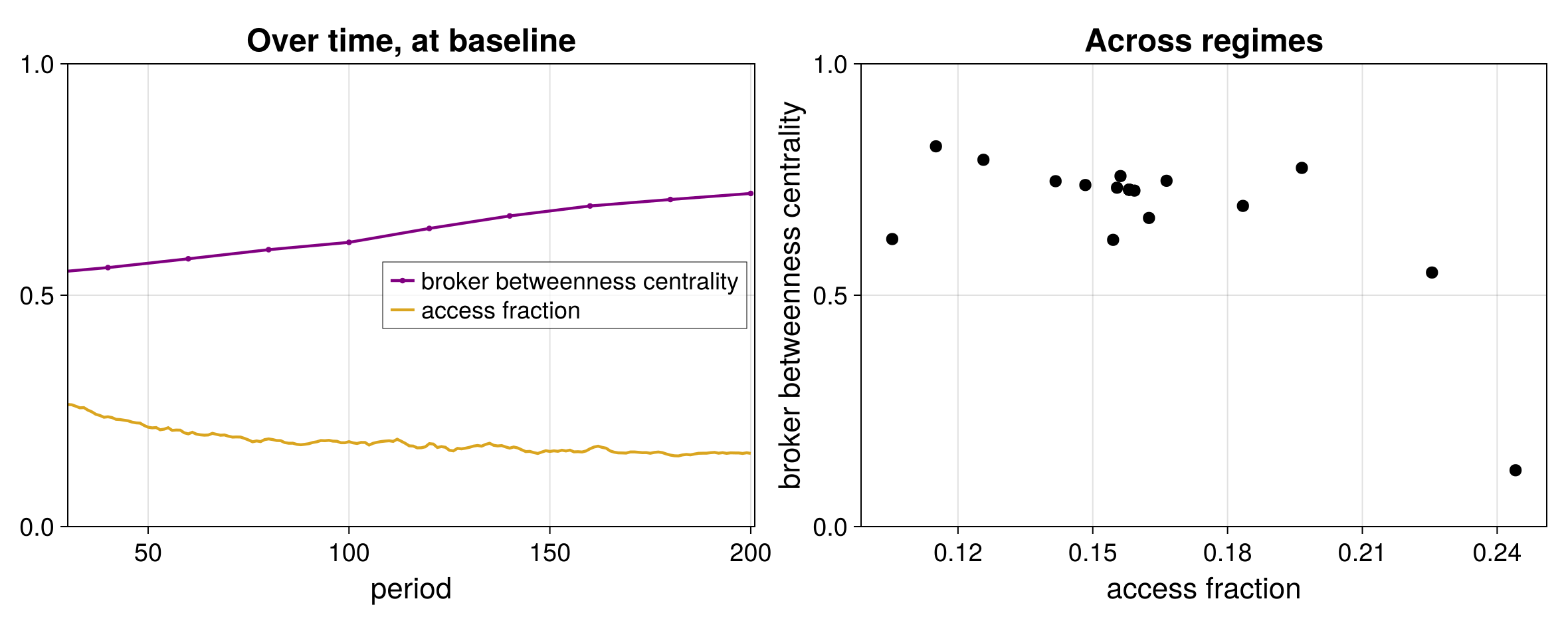
Over time. The broker's betweenness centrality rises even as a smaller share of its matches connect parties not already linked.
Across market regimes. Higher centrality goes with a lower share of such new connections.
A central result
The most central brokers can be the ones that bridge the least.
Broker centrality is endogenous: clients outsource to the broker because its assessments are valuable, not because its bridging position provides access.