
Marie-Lou Laprise
Social scientist studying AI, markets, and institutions
Postgraduate Research Associate, Princeton University
About me
I am a social scientist and lawyer studying collective intelligence and the social impact of AI through the lens of quantitative modeling and legal analysis. I hold a postdoctoral appointment at Princeton University, where I recently completed a Ph.D. in Sociology and a graduate certificate in Statistics and Machine Learning.
My research at the intersection of AI, law, and social science explores what I believe to be one of the key questions of our time, with profound implications for how we live:
- What social dynamics will emerge from the private use of massive amounts of linked digital data and the large-scale deployment of predictive, generative, and agentic AI systems, in a world where access to data and computational capacity is increasingly unequal?
- How will this new information and communication regime reshape social inequality, decision-making processes, and the structure of markets?
- How should legal institutions adapt to these emergent dynamics?
My postdoctoral projects approach this problem from two complementary directions: by modeling collective computation under unequal access to information, and by developing a framework for legal adaptation to AI-driven changes in the scale of social activity. Explore the current research projects.
In my work, I combine the study of emergent behaviors arising in networks of LLM agents and in more traditional agent-based models with the analysis of legal material and empirical data from real markets. I also work on the responsible use of AI for decision-making, social science research, and teaching.
Prior to my doctoral training, I practiced as a commercial trial lawyer in Montreal (Canada), where I handled high-stakes litigation involving shareholder rights, complex tax planning, and trademark infringement. My LL.M. thesis received the 2022 annual thesis prize of the Quebec Association of Law Professors. Part of the thesis became an article cited repeatedly by the Quebec Court of Appeal.
- Collective intelligence in multi-agent networks
- Information asymmetries in markets and institutions
- Law and policy for generative and agentic AI
- Social impacts of the use of machine learning in financial markets
-
Ph.D. in Sociology; Graduate Certificate in Statistics and Machine Learning, 2026
Princeton University, NJ
-
LL.M.; Quebec-wide Annual Thesis Prize, 2021
Université de Montréal, QC
-
LL.B.; Governor General’s Academic Medal, 2013
Université de Sherbrooke, QC
Current Research Projects
Collective Computation in Multi-Agent Networks
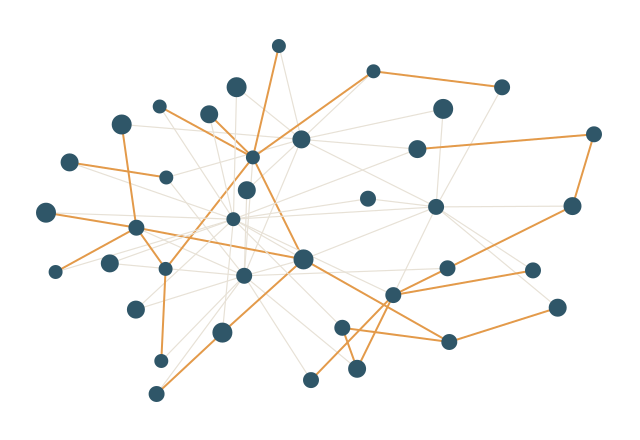
I am developing a new modeling paradigm for studying collective computation in networks of complex learning agents. The modeling framework consists of a network of LLM-style agents, each observing an incomplete part of a structured ground truth. Their task is to reconstruct this ground truth by learning (i) how to communicate valuable information effectively between neighbors and (ii) how to make accurate predictions given incomplete information. The project examines when communication improves collective learning, whether agents specialize, and how unequal access to evidence shapes individual and group performance.
Learn more
Unlike conventional agent-based models, whose agents typically have simple internal states and follow hand-coded interaction rules, these agents have rich learned representations and learn how to communicate. Communication occurs through cross-attention, allowing information exchange to depend on context rather than fixed averaging rules.
As an initial test bed, agents observe different subsets of a low-rank matrix and learn to reconstruct its missing structure collectively. This task provides a known ground truth and explicit performance criteria, making it possible to trace how architecture, training, network structure, and the distribution of evidence shape individual and collective learning.
The framework provides a controlled bridge between multi-agent AI and social-scientific research on collective computation, allowing emergent dynamics to be studied in networks of agents capable of learning complex tasks.
Scale-Aware Law for Generative and Agentic AI
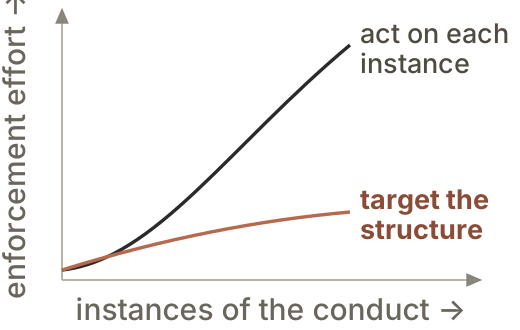
I study how legal frameworks should adapt when generative and agentic AI increase the scale and speed of forecasting, surveillance, communication, and automated action. The project develops a scale-aware framework for updating legal classifications and enforcement, with applications to financial regulation and antitrust.
Read project abstract
Artificial intelligence has given everyone the means for imperfect but nearly unlimited forgery, surveillance, and forecasting. Users are flooding every sphere of human activity with cheap machine predictions, generations, and automations, while developers are beset by an insatiable hunger for data and computing power. The legal order, which must classify conduct and provide the means to enforce its classifications, is stumbling over the scaled-up and sped-up social facts that AI brings about. Faced with a problem of scale, a lawyer’s natural response is to devise or apply general-purpose classifications that encompass conduct of any magnitude, an unspoken inclination I call legal scale-invariance. If legal categories do not hinge on scale, then all conduct, no matter how disproportionate, may fall under the umbrella of the law on the books. When classification is scale-invariant, however, responding to scaled up facts requires us to scale up enforcement proportionally: handle more cases faster, devote more resources, automate more processes. This aligns with the temptation to think that AI can solve the problems that AI creates.
Meeting every instance, at the scale AI produces, requires making classification more rule-like and less grounded in facts, and enforcement more total and less informed by common sense and discretion. In turn, algorithmic classification and indiscriminate enforcement make the law less fair and the legal order less free. Genuine attempts to protect the law’s integrity end up undermining it. Meanwhile, problems not directly tied to volume go unaddressed. More of the same can be hard to handle, like floods of AI-generated non-consensual pornography. But more is often different in kind, like when large volumes of data, computing power, and state-of-the-art learning methods are used by hedge funds to extract profit in new ways, or by digital platforms to compete with their users. Under the scale-invariance status quo, outdated or dubious classifications and ineffective enforcement leave vulnerable people without protections, harms without compensation, and wrongs without reprobation.
This article develops the idea of scale-aware legal design as a principled alternative, where scale-robust enforcement is made possible by scale-sensitive classification. Varying the categories with the magnitude of conduct lets the machinery of enforcement—though not necessarily its monetary cost—stay bounded as conduct scales up. The best scale-sensitive categories target the structure or institution behind a conduct, or a conduct in the aggregate, as the object of a rule. Enforcement then acts on that structure or aggregate, rather than each instance. This makes enforcement a bounded task whose burden does not grow uncontrollably as instances multiply. It further allows the law to tackle emergent problems that are different in kind from those associated with volume alone: the problems that are caused not by any single instance of a conduct, but by the collective conduct itself, which is more than the sum of its parts. Using financial market regulation and antitrust as illustrations, this article shows how scale-aware design lets the legal order accurately classify and appropriately respond to AI-related social change.
LEGALMIX: Leveraging Legal Logic for Enhanced Reasoning Abilities in Language Models
Joint work with Brandon M. Stewart. I presented this work at the joint graduate certificate colloquium of the Princeton Institute for Computational Science and Engineering and the Center for Statistics and Machine Learning.
Read project abstract
Reasoning language models (LMs) increasingly use scaled-up inference-time computation and reinforcement learning with verifiable rewards (RLVR) to solve difficult problems (DeepSeek-AI, 2025). While RLVR has made possible training on large-scale data, most automatically generated, verifiable reasoning tasks remain concentrated in mathematics, coding, and logic (Stojanovski et al., 2025). How this paradigm can be extended to other domains is a very active area of research. We are developing LEGALMIX, an open framework for generating difficult, verifiable legal reasoning tasks.
Existing legal benchmarks generally ask models to infer legal rules or outcomes from supplied language and facts (LegalBench, Guha et al., 2023; LEXam, Fan et al., 2025), while recent legal data-generation systems produce conventional question-answer examples (KgDG/LawGPT, Zhou et al., 2025) or reasoning trace evaluation for judgment-outcome predictions (LEGIT, Lee et al., 2026). LEGALMIX instead provides law-to-facts tasks: given a factual setting and a combination of legal rules, a model must create a coherent fact pattern in which all of them clearly apply. As the number of rules increases, generation difficulty grows, while verification difficulty stays constant.
LEGALMIX combines a prompt generator with a verifier that can return binary rewards or graded scores. Its compositional design can generate millions of prompts from a modest, customizable collection of attributes, supporting the creation of both fixed benchmarks and dynamic post-training data. LMs can be right for wrong reasons, when they follow familiar patterns rather than rigorously applying underlying rules. Existing frameworks do not satisfactorily evaluate this risk, which can jeopardize critical legal AI applications. We hypothesize that by reducing this reliability gap for law, LEGALMIX may also strengthen LM reasoning capabilities across domains. We plan to release the generator and verifier, together with results for leading reasoning and non-reasoning language models.
Selected Research Outputs
Dissertation Research
My dissertation examined the transformation of financial markets and economic actors after the digital turn, with a focus on the consequences of outsourcing relational work: evaluation to corporate brokers, social prediction to AI systems and their developers, and contract enforcement to debt collectors.
Brokers Who Do Not Bridge: When Assessment, Not Access, Shapes Broker Advantage
I develop a social theory of transient brokerage that challenges the view of brokerage as an inherently fragile structural position. I show how corporate intermediaries use the data generated by their activities, the predictions derived from them, and the legal protection of the corporate form to progress from matchmaking to market capture.
I translate this theory into a reproducible agent-based model with neural-network learning, in which a broker acquires knowledge from repeated matching work, to simulate how intermediaries can convert structural capital into informational advantage. When brokers primarily provide assessment rather than access, bridging position and bridging behavior are decoupled, and broker centrality is a product, not a primary source, of matchmaking quality. In that way, the broker can become most central in regimes in which it bridges the least.
Explore the paper: Brokers Who Do Not Bridge
Read abstract
Structural theories describe economic brokerage as an opportune but fragile position bridging gaps between otherwise disconnected actors. In that view, brokering can undermine trust or eliminate the gaps that generate its value, and brokers need supporting institutions or deeper interpersonal ties to stabilize their role. Yet many corporate actors in positions of brokerage, from Visa to Amazon, have risen in market power, profit, and prominence even as networks transformed around them. When can brokering strengthen rather than undermine a broker’s advantage?
I reconceptualize brokerage as outsourced relational work, in which the broker assumes no inventory risk and constructs viable matches between parties who cannot easily find or evaluate one another. Repeated matchmaking generates an informational byproduct that the broker can accumulate: knowledge of what makes pairings successful across the market, unavailable to clients who observe only their own dealings. An agent-based model of a matching market identifies conditions under which this informational advantage emerges and persists. Brokerage can provide assessment rather than access: clients outsource matching even when they can reach counterparties themselves, because the broker’s predictions are valuable. Counterintuitively, the broker can become most central in regimes where it engages in the least bridging behavior: broker centrality is a product, not a primary source, of matchmaking quality.
While the model explores the dynamics of the broker’s informational advantage, I theorize how this advantage can support a transition from intermediation to capture by the broker, as the broker becomes a principal selling the resource it once intermediated or monetizing data and analytics. Brief examples illustrate this transition. This is transient brokerage, a process that highlights how brokerage can disappear because of the broker’s growing power rather than its fragility.
Available: Download manuscript (PDF).
Complex Patterns, Indeterminate Futures, and the Limits of AI for Social Prediction
Drawing on complexity science and information theory, I develop a pre-modeling framework for defining prediction problems that distinguishes two sources of difficulty, complexity and indeterminacy, and clarifies the uses and limits of machine learning in social decision-making.
Read abstract
AI has produced striking improvements in some prediction tasks but limited progress in forecasting human life trajectories; nonetheless, institutions use it to guide decisions. Explanations for this uneven performance commonly begin after a quantity is estimated, focusing on data quality, model capacity, or estimation error. Drawing on complexity science and information theory, this article develops a pre-modeling framework for defining prediction problems. Relations among observer, target, and estimand determine how target information storage and production contribute to two sources of prediction difficulty. Complexity arises when an estimand preserves intricate stored structure that the observer struggles to learn. Indeterminacy arises when an estimand depends on novel information produced beyond the observer’s control. Machine learning can exploit complexity but cannot resolve indeterminacy. Four illustrations show how institutional and practical constraints shape prediction difficulty and the uses and limits of machine learning in social decision-making. A technical appendix provides a complete information-theoretic formalization.
Status: Under review at Sociological Science; manuscript available on demand.
Financial Estrangement
With Frederick F. Wherry and Edward P. Freeland, I examined how debt collection and economic precarity shape institutional trust. The project drew on an original probability survey of 2,115 U.S. adults and custom R code for weighted nonlinear models, multiple imputation, predictive margins, and simulation-based uncertainty.
Read abstract
Over a quarter of Americans report that their household has been contacted by a debt collector in the past year, and for many, this is their primary encounter with the institutions that enforce private claims. Building on the concepts of predatory inclusion and legal estrangement, we argue that civil debt enforcement constitutes a distinct, stratified pathway to institutional distrust—one that parallels and compounds the criminal justice pathway. We introduce the concept of financial estrangement to theorize how the terms of households’ inclusion in credit markets shape their relations with the institutions that enforce private claims. Drawing on an original probabilistic survey of 2,115 U.S. adults, we show that debt-collection contact is pervasive, racially unequal, and not reducible to differences in household income or financial hardship. Americans overwhelmingly find widespread debt-collection practices unfair, particularly those who have experienced them. Careful analysis reveals that debt-collection contact is associated with perceiving courts as rarely or never fair, even after accounting for hardship levels, income, race/ethnicity, and arrest history. These findings suggest that civil legal processes tied to mass debt contribute to race- and class-stratified patterns of institutional trust.
Status: Under review at American Sociological Review; manuscript available on demand.
Other Research
How Private Equity Owns America
With Charlie Eaton, Albina Gibadullina, and Adam Goldstein (equal co-authors), I examine how private equity operates as a corporate raider, Main Street invader, monopoly builder, and shadow owner across the U.S. economy.
Read abstract
Private equity investment funds command increasing wealth and reach in the US economy, yet the scope and role of private equity (PE) remain ambiguous. This article assembles systematic data to provide a descriptive anatomy of PE’s shifting strategies and ownership patterns in the U.S. since the 1980s. We theorize four interconnected roles: “corporate raider,” “main street invader,” “shadow owner,” and “monopoly-builder.” We then document the changing balance among them over time. We find a shift away from PE’s traditional role as corporate raiders that specialize in restructuring publicly traded firms. PE investors increasingly focus on the agglomeration and rationalization of already private “main street” companies. PE-owned companies also increasingly stay private through longer hold times and sales to other PE funds. PE’s expansion has helped spread the logic of shareholder value maximization to ever-more corners of the economy, but without the relative transparency and regulation of publicly traded companies.
Status: Forthcoming as a Roosevelt Institute white paper; under review at Socio-Economic Review.
Economic Policies During Times of Crisis
With Andreas Wiedemann (equal co-author), I examined how welfare and credit regimes shaped economic policy responses to the COVID-19 crisis.
Read abstract
How much economic support governments offered to households during the Covid-19 pandemic differed considerably across rich democracies. What explains this variation? We argue that institutional structures of welfare and credit regimes shape households’ abilities to address income shortfalls and, as a result, governments’ policy repertoire during crises. In countries with permissive credit regimes, economic support policies were more comprehensive when social policies were limited. Governments not only provided income support but also debt relief to shield households from default risks due to high pre-crisis debt leverage. Yet those countries ceased income support sooner as credit resumed its substitutive role vis-à-vis the welfare state. We provide evidence for our argument by examining pandemic policies from five OECD countries that vary in their social policies, credit access and household indebtedness. Our findings suggest that the privatization of risks imposes financial burdens on households that constrain governments’ policy responses in times of crisis.
Published: Socio-Economic Review (2025); reprinted in Viral Debt (Routledge, 2026).
Discretionary Bars to Action in Quebec Law
I used a systematic review of recent cases to develop a theory of the fin de non-recevoir in Quebec private law, distinguishing absolute from discretionary bars and clarifying how discretionary bars safeguard legal coherence.
Read abstract
The fin de non-recevoir, a type of bar to an action, results in the total and definitive paralysis of an otherwise available right of action. Despite its devastating effects and growing popularity, forty years after its recognition by the Supreme Court of Canada in National Bank v. Soucisse, its contours remain blurry and its substance, ambiguous. The legal community cannot agree on the definition or conditions of this poorly understood and under-theorized doctrine. This Article builds on a systematic review of recent cases to lay the groundwork for a theory of the fin de non-recevoir in Quebec private law. It introduces a crucial distinction, absent from contemporary commentary, between absolute and discretionary bars, it clarifies the role of discretionary bars in safeguarding the coherence of the law, and it systematizes how and when they may apply.
Published: McGill Law Journal (2022); cited repeatedly by the Quebec Court of Appeal.
Teaching
In the fall 2026, I will teach quantitative and computational research methods workshops to incoming graduate students, including mathematical foundations for social science research and the rigorous and ethical use of agentic AI for research and learning.
As a preceptor for the graduate course Advanced Social Statistics at Princeton University, I led tutorial sessions for students, held office hours, and supported them with a semester-long replication project and weekly problem sets. I also served as a guest lecturer in Law, Institutions, and Public Policy and in Comparative Constitutional Law, and I acted as preceptor for a variety of undergraduate courses.
I am prepared to teach classes about quantitative and computational methods at the graduate and undergraduate levels, organizational behavior, economic sociology, business law, law and technology, law and society, and AI and society.